A cheque is commonly used for business transactions, personal payments, loans and settlement of financial obligations. When a cheque is returned unpaid, the situation can quickly develop into a legal dispute. A Cheque Bounce Lawyer in Gurgaon can help the drawer or payee understand the applicable legal process and take appropriate steps in a cheque dishonour matter.
Cheque dishonour cases in India are primarily governed by the Negotiable Instruments Act, 1881, particularly the provisions dealing with dishonour of cheques for specified reasons. The process involves important requirements relating to presentation of the cheque, bank return information, statutory notice and the filing of a complaint within the applicable legal framework.
Whether you are a business owner, individual, creditor, borrower or company dealing with a cheque dispute, timely legal advice can help you understand your position and protect your interests.
Key Takeaways
- Cheque dishonour can have civil as well as criminal-law implications depending on the facts and applicable provisions.
- Section 138 of the Negotiable Instruments Act, 1881 is central to many cheque bounce proceedings.
- Statutory notice and limitation requirements are important in cheque dishonour cases.
- Proper documentation can significantly assist in preparing or defending a case.
- Both the payee and drawer may require legal representation depending on the circumstances.
- Settlement may be possible in appropriate cases.
- Early legal advice can help avoid procedural mistakes.
What Is a Cheque Bounce Case?
A cheque bounce occurs when a bank returns a cheque unpaid instead of honouring the payment instruction.
A cheque may be returned for reasons such as:
- Insufficient funds
- Exceeding an agreed arrangement with the bank
- Account-related issues
- Signature or mandate-related issues
- Stop-payment instructions in circumstances where legal requirements are otherwise satisfied
- Other reasons communicated by the bank
The legal consequences depend on the reason for dishonour and the surrounding facts.
Where the statutory requirements under Section 138 of the Negotiable Instruments Act are satisfied, cheque dishonour may result in criminal proceedings.
Why Hire a Cheque Bounce Lawyer in Gurgaon?
Cheque bounce litigation involves specific procedural requirements. A Cheque Bounce Lawyer in Gurgaon can help a client understand the relevant legal provisions and evaluate the available options.
A lawyer may assist with:
- Reviewing the cheque and underlying transaction
- Examining the bank return memo
- Assessing the legal notice
- Preparing a statutory notice where appropriate
- Drafting a complaint
- Preparing a defence against a cheque bounce complaint
- Representing clients during court proceedings
- Advising on settlement
- Preparing relevant applications
- Advising on appeals and other available remedies
Professional legal assistance can be particularly useful when the cheque is connected with a business transaction, loan, commercial agreement or disputed liability.
Understanding Section 138 of the Negotiable Instruments Act
Section 138 of the Negotiable Instruments Act, 1881 deals with dishonour of a cheque for insufficiency of funds or where the amount exceeds the arrangement with the bank, subject to the statutory conditions.
A cheque dishonour case is not established merely because a cheque was returned unpaid. The statutory requirements must be examined carefully.
The relevant circumstances may include:
- The cheque was drawn on an account maintained by the drawer.
- The cheque was issued towards a legally enforceable debt or liability.
- The cheque was presented within the applicable validity period.
- The bank returned the cheque unpaid for a reason covered by the applicable provision.
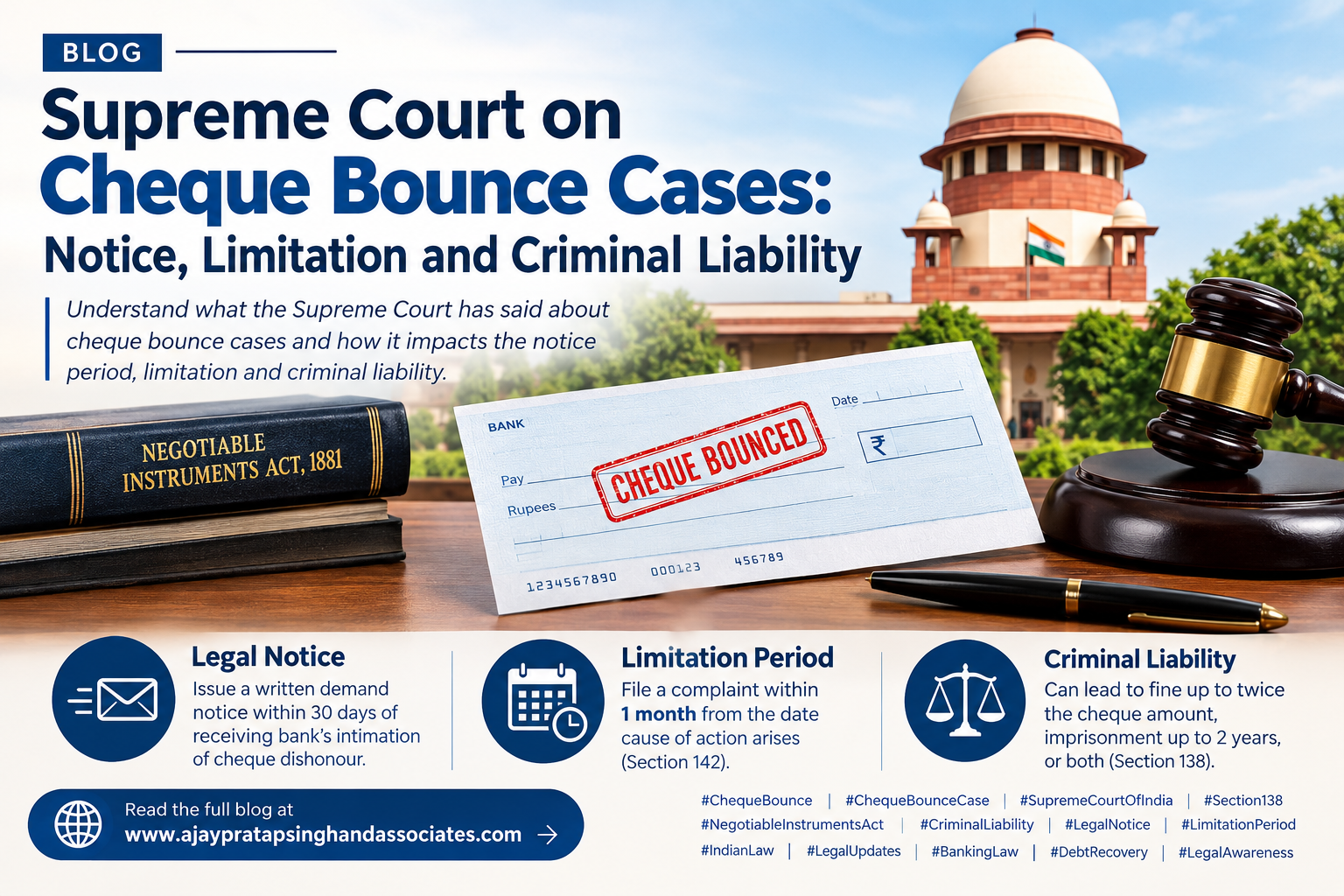
- The payee or holder in due course issued the required statutory notice within the prescribed period after receiving information regarding dishonour.
- The drawer failed to make payment within the statutory period after receiving the notice.
- The complaint was filed within the applicable limitation period, subject to the law governing the particular case.
Because these requirements are procedural as well as substantive, every case should be examined individually.
Importance of the Statutory Legal Notice
The statutory notice is an important part of a cheque dishonour proceeding under Section 138.
The notice generally communicates:
- Details of the dishonoured cheque
- Date and amount of the cheque
- Information regarding dishonour
- Demand for payment
- Relevant transaction details
- Consequences of failure to comply
The notice must be prepared and served in accordance with the applicable legal requirements.
A defective or poorly prepared notice can create unnecessary complications. Therefore, the underlying documents and bank records should be reviewed before sending a legal notice.
What Happens After a Cheque Is Dishonoured?
The general process may involve the following stages:
Step 1: Cheque Presentation
The cheque is presented to the bank within the applicable validity period.
Step 2: Dishonour
The bank returns the cheque unpaid and provides a return memo or other information recording the reason for dishonour.
Step 3: Legal Notice
Where the statutory conditions are satisfied, the payee or holder in due course may issue the required demand notice within the prescribed timeframe.
Step 4: Opportunity for Payment
The drawer receives the statutory opportunity to make payment within the period specified under the applicable law.
Step 5: Filing of Complaint
If the statutory requirements are fulfilled and payment is not made within the applicable period, a complaint may be filed before the appropriate court within the prescribed limitation period.
Step 6: Court Proceedings
The court may conduct proceedings according to the applicable procedural and substantive law.
The exact process can vary according to the facts and procedural developments of the case.
What Is a Legally Enforceable Debt?
One of the important issues in many cheque dishonour cases is whether the cheque was issued towards a legally enforceable debt or liability.
The underlying transaction may involve:
- Business payments
- Loans
- Outstanding invoices
- Sale transactions
- Services provided
- Settlement of accounts
- Contractual obligations
- Other financial liabilities
The parties should preserve documents supporting the underlying transaction.
Depending on the dispute, relevant evidence may include agreements, invoices, account statements, bank records, correspondence and acknowledgements.
Defences in Cheque Bounce Cases
A person facing a cheque bounce complaint may have legal grounds of defence depending on the facts.
Potential issues may include:
- Dispute regarding the underlying liability
- Absence of a legally enforceable debt
- Dispute concerning issuance of the cheque
- Material alteration
- Improper presentation
- Procedural defects
- Dispute regarding statutory notice
- Limitation-related issues
- Payment already made
- Dispute concerning the authority or circumstances under which the cheque was issued
The strength of a defence depends on the evidence and circumstances of the individual case.
A drawer should not assume that simply claiming the cheque was issued as security automatically resolves the matter. The legal effect of a security cheque depends on the facts and applicable law.
Security Cheques and Cheque Bounce Disputes
Security cheques frequently become the subject of litigation.
Businesses may receive post-dated or security cheques as part of commercial arrangements. If such a cheque is later presented and dishonoured, the legal consequences depend on the nature of the underlying liability and other facts.
The parties should therefore preserve:
- Agreements
- Payment schedules
- Invoices
- Account statements
- Correspondence
- Settlement documents
- Records showing the purpose for which the cheque was issued
The description of a cheque as a “security cheque” by itself should not be treated as a complete answer to the legal dispute.
Cheque Bounce Cases Involving Businesses
Cheque dishonour can create serious commercial problems for businesses.
A company may issue or receive cheques in connection with:
- Vendor payments
- Customer transactions
- Loans
- Security arrangements
- Supply contracts
- Service agreements
- Business settlements
A cheque dispute can also be connected with a larger contractual disagreement.
Businesses should therefore review the complete commercial transaction rather than focusing only on the dishonoured cheque.
Maintaining proper accounting records and transaction documentation can be valuable when a dispute arises.
Cheque Bounce and Company Transactions
When a cheque is issued by a company, questions can arise regarding the role and responsibility of individuals associated with the company.
The liability of directors, authorised signatories or other persons cannot simply be assumed. The applicable statutory requirements and the person’s role in the conduct of the company’s business need to be examined according to the facts.
This makes legal assessment particularly important in company-related cheque dishonour litigation.
Documents Required for a Cheque Bounce Case
Before consulting a lawyer, organise the relevant documents.
These may include:
- Original cheque or available copy
- Bank return memo
- Bank statements
- Legal notice
- Proof of service of notice
- Loan agreement
- Invoice or purchase order
- Business agreement
- Account statements
- Payment records
- Email and message correspondence
- Settlement documents
- Previous legal notices
- Court documents, if proceedings have already started
The exact documents required depend on whether you are the complainant or the accused.
Role of a Cheque Bounce Lawyer for the Payee
If you are the payee or holder of a dishonoured cheque, a lawyer can help evaluate the transaction and determine the appropriate legal steps.
The lawyer may assist with:
- Reviewing the cheque
- Examining the return memo
- Assessing the underlying liability
- Preparing the statutory notice
- Advising on service of notice
- Preparing the complaint
- Representing the complainant
- Responding to the defence raised by the drawer
- Advising on settlement
- Handling related proceedings where appropriate
Role of a Cheque Bounce Lawyer for the Accused
A person facing a cheque bounce complaint should understand the allegations and examine the complete transaction.
Legal assistance may include:
- Reviewing the complaint
- Examining the cheque and bank records
- Analysing the underlying transaction
- Identifying potential legal defences
- Preparing responses and applications
- Representing the accused during proceedings
- Advising on settlement
- Advising on available appellate or other remedies
Ignoring a court summons or proceeding without understanding the case can create avoidable difficulties.
Can Cheque Bounce Cases Be Settled?
Depending on the circumstances, cheque dishonour disputes may be resolved through settlement.
A settlement may address:
- Principal amount
- Interest
- Litigation expenses
- Payment schedule
- Withdrawal or disposal of proceedings
- Other agreed obligations
Any settlement should be documented carefully and should clearly state the obligations of each party.
Common Mistakes in Cheque Bounce Cases
Delaying Legal Action
Statutory timelines can be important. Unnecessary delay may affect available remedies.
Losing Bank Documents
The return memo and other bank records can be important evidence.
Sending an Incorrect Legal Notice
The notice should be prepared after reviewing the relevant documents and legal requirements.
Ignoring Court Proceedings
A person who receives a court summons should obtain legal advice and respond appropriately.
Relying Only on Oral Agreements
Written contracts, invoices, account statements and correspondence can be valuable evidence.
Assuming Every Dishonoured Cheque Automatically Creates Liability
The statutory requirements and facts of the particular case must be examined before reaching such a conclusion.
How to Choose the Right Cheque Bounce Lawyer in Gurgaon
When choosing legal representation, consider experience in:
- Section 138 cheque dishonour matters
- Negotiable Instruments Act litigation
- Commercial disputes
- Banking disputes
- Business transactions
- Criminal litigation
- Civil recovery proceedings
- Settlement and mediation
- Trial court proceedings
- Appeals and related litigation
A good lawyer should explain the legal process clearly and provide realistic advice based on the documents and facts.
For professional legal assistance and information about the firm’s legal services, visit https://manindersinghandassociates.in/.
Practical Steps After Receiving a Cheque Bounce Notice
If you receive a legal notice concerning a dishonoured cheque:
Step 1: Do not ignore the notice.
Step 2: Preserve the cheque and bank documents.
Step 3: Review the underlying transaction.
Step 4: Collect agreements, invoices and payment records.
Step 5: Check whether any payment has already been made.
Step 6: Obtain legal advice regarding the allegations and applicable timelines.
Step 7: Consider whether settlement or litigation is the appropriate course.
Frequently Asked Questions
What does a Cheque Bounce Lawyer in Gurgaon do?
A cheque bounce lawyer assists clients with legal issues arising from dishonoured cheques, including statutory notices, complaints, defence, court proceedings and related remedies.
What law applies to cheque bounce cases in India?
Cheque dishonour cases under Section 138 are primarily governed by the Negotiable Instruments Act, 1881 along with applicable procedural laws.
How long do I have to respond to a cheque bounce notice?
The statutory framework provides a specified period for the drawer to make payment after receiving the required notice. The exact dates should be calculated carefully from the relevant documents and proof of service.
Can a security cheque result in a cheque bounce case?
A security cheque can become part of a cheque dishonour dispute. Whether Section 138 applies depends on the facts, including whether a legally enforceable debt or liability existed when the cheque was presented and the other statutory requirements were satisfied.
Can a cheque bounce case be settled?
Cheque dishonour disputes may be settled in appropriate circumstances. The terms should be documented clearly and handled according to the applicable legal procedure.
What should I do if I receive a cheque bounce summons?
Do not ignore it. Obtain the complete court documents and consult a qualified lawyer promptly so that the applicable response and procedural requirements can be assessed.
Can a business file a cheque bounce case?
A company or other eligible payee may pursue appropriate remedies where the statutory requirements are satisfied. The facts, documentation and legal status of the parties should be examined.
Conclusion
Cheque dishonour disputes can involve strict procedural requirements and important financial consequences. Whether you are a payee seeking recovery or a drawer defending a complaint, understanding the legal process is essential.
A Cheque Bounce Lawyer in Gurgaon can assist with reviewing the underlying transaction, preparing or responding to legal notices, handling court proceedings and evaluating settlement or other available remedies.
Timely legal advice can help ensure that important documents, statutory timelines and procedural requirements are properly considered.
For more information about legal assistance, visit https://manindersinghandassociates.in/.
Disclaimer
This article is intended for general informational purposes only and does not constitute legal advice or create an advocate-client relationship. Cheque dishonour cases depend on their specific facts, documents and applicable law. Consult a qualified lawyer before taking legal action.