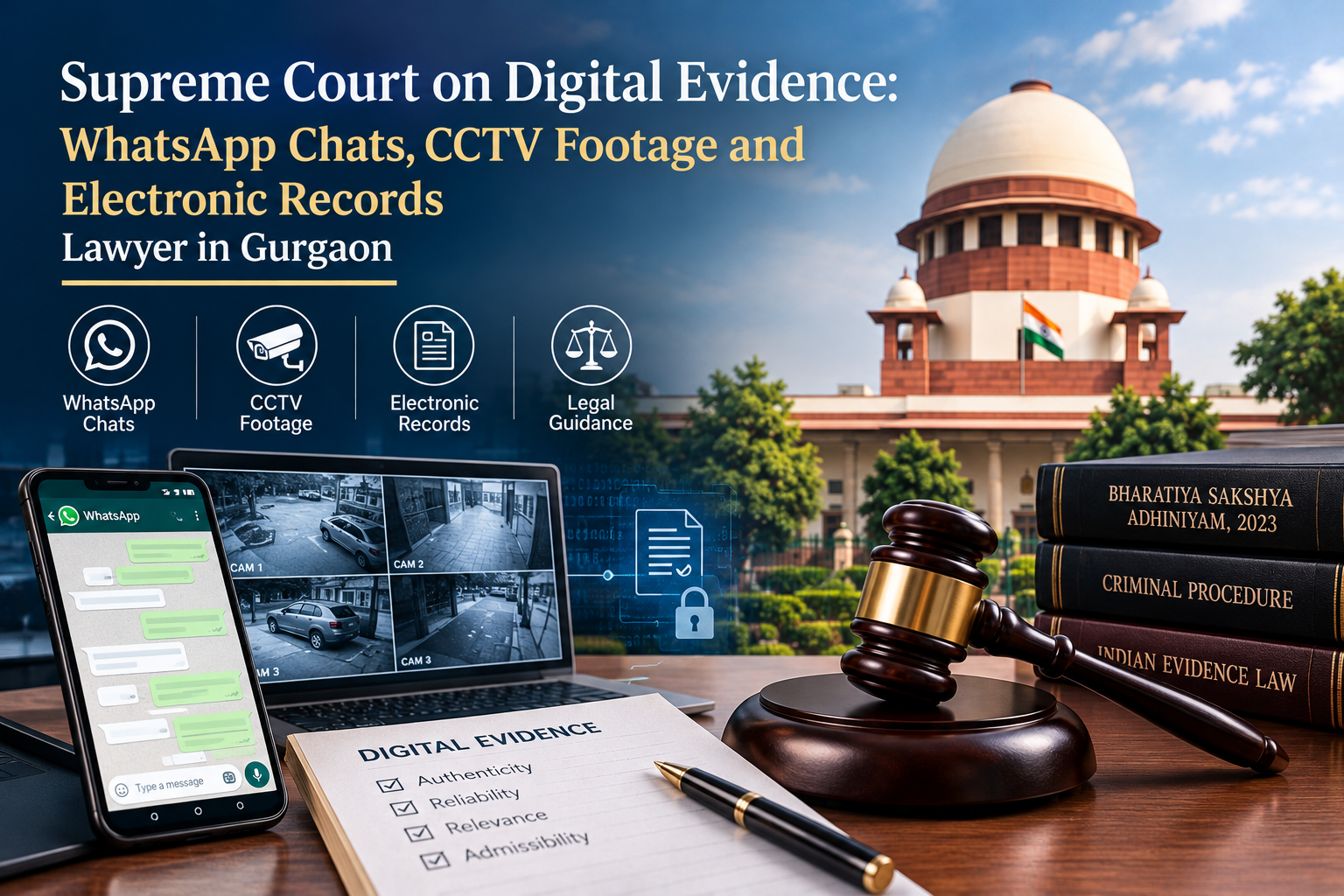
The Supreme Court on Digital Evidence: WhatsApp Chats, CCTV Footage and Electronic Records Lawyer in Gurgaon is a relevant topic for individuals and businesses dealing with criminal litigation, electronic communications, cybercrime allegations and disputes involving digital records. WhatsApp conversations, CCTV recordings, emails, call records, photographs and other electronic material can play an important role in legal proceedings. However, the existence of a digital file does not automatically establish that it is authentic, reliable or admissible in court.
Indian courts examine electronic evidence under the applicable law, including the Bharatiya Sakshya Adhiniyam, 2023 (BSA), where applicable. The law contains specific requirements concerning electronic records and their proof. Courts may also consider whether the evidence has been preserved properly, whether its source can be established and whether it supports the facts being alleged.
The Supreme Court of India has addressed important questions concerning the admissibility and reliability of electronic evidence. Its decisions help explain why legal compliance, authenticity and the integrity of digital records matter during a trial.
For people seeking legal assistance in Gurgaon, understanding these principles can help them prepare for disputes involving digital communications, CCTV footage and electronic documents. For more information about legal services, visit https://manindersinghandassociates.in/.
Key Takeaways
- Digital evidence can include WhatsApp chats, CCTV footage, emails, photographs, call records and other electronic files.
- The Bharatiya Sakshya Adhiniyam, 2023, governs important aspects of electronic evidence for proceedings to which it applies.
- Section 63 of the BSA addresses the admissibility of electronic records produced in the manner covered by that provision.
- A certificate or other procedural requirement does not automatically establish the truth or reliability of every statement in a digital file.
- Preserving original files and relevant devices can help address questions about authenticity and integrity.
- Edited screenshots, incomplete conversations and unexplained gaps can affect how digital evidence is evaluated.
- The applicable legal requirements may differ depending on the date and nature of the proceedings.
1. What Is Digital Evidence in Indian Courts?
Digital evidence is information stored, transmitted or generated electronically that may be relevant to a legal proceeding. It can help establish the sequence of events, communication between parties, the presence of a person at a particular location or other facts in dispute.
Digital material may be relied upon in criminal trials, civil disputes, matrimonial litigation, commercial matters and cybercrime investigations, subject to the applicable law and relevance requirements.
Common examples include:
- WhatsApp messages and chat exports.
- CCTV footage and video recordings.
- Emails and email attachments.
- Photographs and audio recordings.
- Mobile phone and computer records.
- Call detail records and location-related information.
- Digital transaction records.
- Social media posts and messages.
- Electronic documents and files stored on devices or servers.
The legal significance of any particular record depends on what it is intended to prove, how it was obtained and whether the applicable requirements for admissibility and proof are satisfied.
Admissibility and Evidentiary Value Are Different
A digital record may be produced before a court, but that alone does not establish that its contents are genuine or correct.
Admissibility concerns whether the evidence can legally be received and considered by the court. Evidentiary value concerns the weight the court should give it when deciding the disputed facts.
A WhatsApp screenshot, for example, might be relevant to a dispute. The court may still need to consider who sent the messages, whether the conversation is complete, whether the record has been altered and whether the applicable legal requirements have been met.
2. Supreme Court Principles on Electronic Evidence
The Supreme Court has developed important principles concerning the proof of electronic records under Indian evidence law.
One leading authority is Arjun Panditrao Khotkar v. Kailash Kushanrao Gorantyal (2020), which considered the requirements under Section 65B of the former Indian Evidence Act, 1872. The judgment addressed the certification requirements for secondary electronic evidence under that earlier law.
The current BSA contains its own provisions governing electronic records. Section 63 addresses the admissibility of electronic records produced in the manner covered by the provision, including specified certification requirements.
Earlier judgments remain important for understanding the development of electronic-evidence law, but their principles must be applied carefully alongside the current statutory text and any relevant later decisions.
Supreme Court Order on Section 63 of the BSA in 2026
In Pune Bar Association v. Union of India, Writ Petition (Civil) No. 599 of 2026, the Supreme Court considered a challenge concerning Section 63(4) of the BSA and its prescribed certificate for electronic records.
In its order dated 22 May 2026, the Court discussed the purpose of requirements such as identifying electronic records, recording hash values and obtaining expert certification under the prescribed framework. It explained the relationship between these requirements and the objective of protecting the authenticity and integrity of electronic evidence.
The Court did not give a conclusive opinion on every question concerning the expert-certification requirement; it kept the relevant question of law open while disposing of the petition.
Read the order here: Pune Bar Association v. Union of India — Supreme Court order.
The practical lesson is that electronic evidence should be prepared and presented in accordance with the applicable statutory requirements. The precise requirements should be checked against the law and the circumstances of the particular proceeding.
3. WhatsApp Chats as Evidence in Court
WhatsApp conversations may become relevant in disputes involving alleged threats, financial transactions, contractual communications, matrimonial issues, harassment or other matters.
However, a screenshot should not automatically be treated as conclusive proof of the entire conversation or the identity of the person responsible for a message.
What Do Courts Need to Consider?
Depending on the case, relevant questions may include:
- Can the participants in the conversation be identified?
- Is the date and time information reliable?
- Does the record show the relevant conversation in context?
- Are there indications of editing, deletion or manipulation?
- Is the message supported by other evidence?
- Have the applicable requirements for proving the electronic record been satisfied?
The significance of a WhatsApp conversation depends on the issue it is being used to prove. A message may establish that certain words were communicated, but it may not necessarily prove the truth of every statement contained in it.
How to Preserve WhatsApp Evidence
If a conversation may be relevant to a legal matter, consider taking the following steps:
- Preserve the original conversation on the device where it is available.
- Avoid editing screenshots or altering exported chat files.
- Retain relevant attachments, photographs, audio files and associated messages.
- Record the context in which the conversation occurred.
- Keep information about the device and the source of the record where relevant.
- Seek legal advice before deleting, resetting or replacing a device that may contain important evidence.
Screenshots can be useful for reference, but the appropriate method of proving the record must be assessed under the applicable law.
4. CCTV Footage as Digital Evidence
CCTV recordings may be relevant in cases involving theft, assault, road incidents, workplace disputes, property disputes and allegations about a person’s presence at a particular location.
The evidentiary value of CCTV footage depends on more than whether a recording exists. Its relevance, authenticity, completeness and connection to the disputed event may all need to be examined.
Important Questions About CCTV Recordings
A court or investigating authority may need to consider:
- Whether the camera covered the relevant area.
- Whether the recording corresponds to the date and time in question.
- Whether the footage is complete or contains gaps.
- Whether the time displayed by the system is accurate.
- Whether the original recording or an appropriate copy has been preserved.
- Whether the source and integrity of the recording can be established.
- Whether the applicable statutory requirements for electronic evidence have been met.
The absence of audio, a poor camera angle or limited image quality may affect what can reasonably be inferred from a recording. CCTV footage should not be treated as proof of facts that it does not actually show.
Preserving CCTV Footage Promptly
CCTV systems may automatically overwrite older recordings. Where footage could be relevant to a dispute or investigation, a person may need to request preservation promptly and keep a record of the request.
Depending on the circumstances, it may be useful to identify the camera, location, date and approximate time of the incident. Any transfer to a storage device should be handled in a way that preserves the source and integrity of the recording.
A lawyer can help assess the appropriate steps for preserving and presenting the footage.
5. Section 63 of the Bharatiya Sakshya Adhiniyam, 2023
The Bharatiya Sakshya Adhiniyam, 2023, provides the current statutory framework for evidence in proceedings to which it applies. Sections 61 and 62 address electronic or digital records and their proof, while Section 63 deals with the admissibility of electronic records in the circumstances specified by the provision.
The exact statutory requirements should be checked before relying on an electronic record in court.
Why Is the Certificate Important?
Section 63 contains requirements concerning the production of specified electronic records and the certificate prescribed by the law. The certificate and related technical details help address the source and integrity of the record.
A party relying on a copy of an electronic record should not assume that simply printing a screenshot, copying a video to a pen drive or attaching a file to an application is sufficient in every case.
The correct approach depends on how the record is produced, whether the original device is available, the statutory conditions and the nature of the proceedings.
Does a Certificate Automatically Prove the Evidence Is Genuine?
No. Compliance with the applicable certification requirements is not the same as establishing every disputed fact.
A court may still need to assess authenticity, reliability, relevance and the connection between the electronic record and the issue being decided. The other party may also raise legally relevant objections about the source, context or integrity of the record.
The statutory requirements and the evidentiary weight of the material should therefore be considered separately.
For the statutory text, consult the official India Code version of the Bharatiya Sakshya Adhiniyam, 2023.
6. What Happens When Digital Evidence Is Allegedly Altered?
Digital records can sometimes be edited, cropped, converted or otherwise modified. Such changes may be legitimate in some contexts, but unexplained alterations can create questions about whether the material accurately represents the original record.
Allegations of manipulation should be supported by relevant facts or technical material rather than assumptions.
Indicators That May Require Examination
Depending on the evidence, a lawyer or technical expert may examine:
- Missing portions of a conversation or recording.
- Inconsistencies in timestamps or file information.
- Differences between an original file and a produced copy.
- Unexplained changes in image, audio or video quality.
- The method used to extract or transfer the record.
- Whether the available material can be compared with a reliable original.
A hash value can assist in checking whether a file has changed between defined points of comparison. However, it does not by itself prove who created the file, whether its contents are truthful or whether the recording accurately depicts the event.
Where authenticity is disputed, technical examination may be appropriate, subject to the circumstances and applicable procedural rules.
7. Digital Evidence in Criminal and Cybercrime Cases
Electronic evidence can play a significant role in investigations involving alleged online fraud, impersonation, threats, unauthorised access and other technology-related offences.
It may also be relevant in ordinary criminal cases where communications, recordings or electronic records help establish the facts.
What Should a Person Do if Digital Evidence Is Involved?
If a person is a complainant or accused in a matter involving electronic records, practical steps may include:
- Preserving the original files and relevant devices where lawful and appropriate.
- Keeping copies of relevant communications without changing their contents.
- Recording the source and circumstances in which the evidence was obtained.
- Avoiding unauthorised access to another person’s account or device.
- Following lawful instructions from the investigating authority.
- Obtaining legal advice about preservation, disclosure and admissibility.
No one should attempt to fabricate, delete or manipulate material to influence a court proceeding or investigation. Such conduct can create additional legal problems.
8. Digital Evidence in Civil, Matrimonial and Commercial Disputes
Electronic records are not limited to criminal litigation. They may also be relevant to contractual disputes, business transactions, matrimonial proceedings and other civil matters.
For example, email correspondence may be relied upon to explain the terms discussed during a business transaction. WhatsApp messages may be relevant to a dispute about communication between parties. CCTV footage may help establish events at a business premises or residential property.
In each situation, the court must determine what the record actually proves and whether it meets the applicable legal requirements.
The relevance of a message does not automatically establish the truth of its contents. Similarly, a recording may show that a person was present at a location without proving that the person committed a particular act.
Legal arguments should focus on the precise issue in dispute and the evidence available to support it.
9. Choosing Legal Assistance for Digital Evidence Matters in Gurgaon
Matters involving electronic evidence may require an understanding of evidence law, criminal procedure, document preservation and, in some cases, technical questions about the source or integrity of a file.
Individuals dealing with WhatsApp chats, CCTV footage or electronic records should seek advice suited to the nature and stage of their proceedings.
Before discussing a matter with a lawyer, it may help to organise:
- A short timeline of the relevant events.
- The original electronic records available.
- Copies of relevant notices, complaints or court orders.
- Information about where the records came from.
- Any certificate or technical documentation already available.
- A list of specific questions or objections concerning the evidence.
Maninder Singh & Associates can be contacted through its website for information about legal services. Visit https://manindersinghandassociates.in/ to learn more.
The appropriate legal strategy depends on the facts, the applicable law and the procedural stage. No particular result can be guaranteed.
10. How to Verify Supreme Court Judgments on Digital Evidence
Legal research should begin with the actual judgment rather than a headline, social media post or unverified summary.
A useful verification process includes:
- Search the official Supreme Court of India website.
- Confirm the case name, decision date and citation.
- Read the relevant passages in the original judgment or order.
- Identify the statute and provision being interpreted.
- Check whether the decision concerns the former Evidence Act or the current BSA.
- Review subsequent decisions or statutory developments that may affect its application.
- Apply the legal principle to the facts of the particular matter.
This is especially important where an older judgment refers to Section 65B of the Indian Evidence Act, 1872, while the current statutory framework may require consideration of Section 63 of the BSA.
Conclusion
The Supreme Court on Digital Evidence: WhatsApp Chats, CCTV Footage and Electronic Records Lawyer in Gurgaon highlights the growing importance of electronic records in Indian litigation. WhatsApp messages, CCTV recordings, emails and other digital files can help establish relevant facts, but their legal significance depends on authenticity, reliability, relevance and compliance with the applicable rules of evidence.
Section 63 of the Bharatiya Sakshya Adhiniyam, 2023, is an important provision for electronic records produced in the manner covered by that section. Supreme Court decisions, including the May 2026 order in Pune Bar Association v. Union of India, help explain why the statutory framework places importance on the integrity and verification of digital evidence.
People dealing with digital evidence should preserve relevant records, avoid altering original material and seek legal advice when admissibility or authenticity is disputed. A careful approach can help ensure that evidence is evaluated on its actual merits and under the correct legal framework.
For information about legal services, visit https://manindersinghandassociates.in/.