A cheque is commonly used for business payments, personal transactions, loan repayments and settlement of outstanding dues. However, when a cheque is returned unpaid by the bank, the person who received it may face delays in recovering the money. In such circumstances, understanding the legal remedies available under the Negotiable Instruments Act, 1881 becomes important.
A Section 138 NI Act Lawyer in Gurgaon can help individuals, business owners, traders and companies understand the legal process involved in cheque dishonour cases. Legal assistance may include reviewing the cheque and bank return memo, preparing a statutory demand notice, filing a complaint, responding to allegations or representing a party during court proceedings.
Section 138 of the Negotiable Instruments Act, 1881 provides a legal framework for certain cases in which a cheque issued towards a legally enforceable debt or liability is dishonoured and the statutory conditions are fulfilled. However, every returned cheque does not automatically result in criminal liability. The reason for dishonour, the underlying transaction, compliance with statutory timelines and the available evidence must be examined.
Maninder Singh & Associates provides legal services relating to cheque bounce disputes and other legal matters. To learn more about the firm’s services, visit https://manindersinghandassociates.in/.
This guide explains the key provisions of Section 138, the legal notice procedure, important deadlines, possible defences and how a lawyer can assist with cheque dishonour proceedings in Gurgaon.
Key Takeaways
- Section 138 of the Negotiable Instruments Act, 1881 deals with specified cases of cheque dishonour involving a legally enforceable debt or liability.
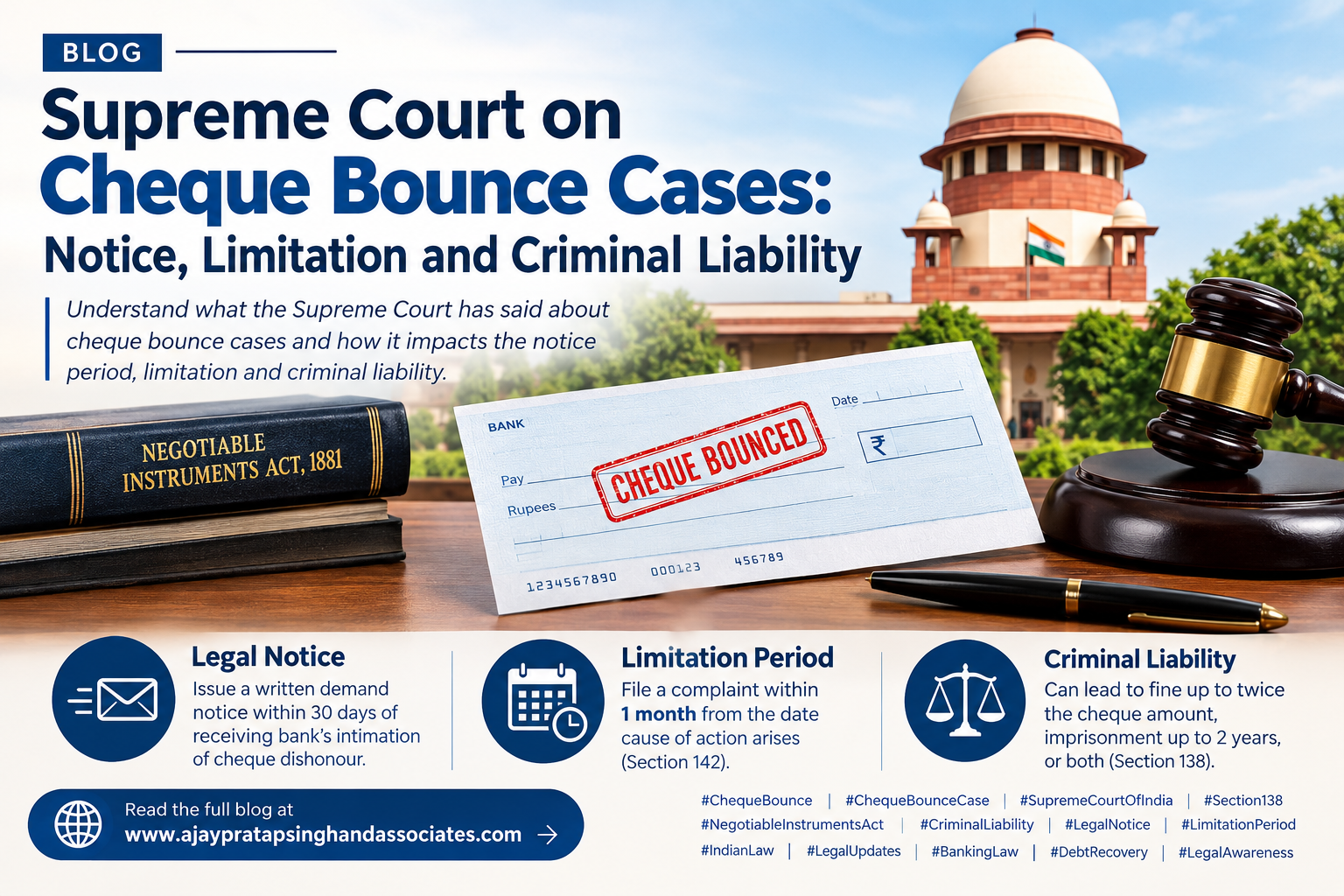
- The payee or holder in due course generally must issue a written demand notice within 30 days of receiving information from the bank about cheque dishonour.
- The cheque drawer generally has 15 days from receipt of the statutory demand notice to make the demanded payment.
- If payment is not made within the statutory period, a complaint may be filed within the prescribed limitation period, subject to applicable legal provisions.
- Bank return memos, the original cheque, transaction records, notices and proof of delivery can be important evidence.
- A lawyer can help assess the facts, prepare documents, calculate deadlines and represent the client in the appropriate court.
What Is Section 138 of the Negotiable Instruments Act, 1881?
Section 138 of the Negotiable Instruments Act, 1881 addresses cheque dishonour in specified circumstances. It aims to support confidence in cheque-based transactions by providing legal consequences where the statutory requirements are satisfied.
A cheque may be returned unpaid for different reasons, including insufficient funds, an amount exceeding the agreed arrangement with the bank or other circumstances recognised under applicable law. Whether Section 138 applies depends on the facts and the legal requirements of the particular case.
Essential conditions for a Section 138 case
Generally, the following conditions are relevant:
1. A cheque must have been drawn on an account maintained by the drawer.
The cheque must satisfy the requirements of the applicable provision. The parties should preserve the original cheque and related transaction documents.
2. The cheque must relate to a legally enforceable debt or liability.
The cheque should have been issued towards payment of a legally enforceable debt or other liability. The nature of the underlying transaction may be established through agreements, invoices, account statements, loan records or other relevant evidence.
3. The cheque must be presented within its validity period.
A cheque should ordinarily be presented within its validity period, generally three months from its date under the applicable banking directions. The actual validity and presentation requirements should be checked for the particular instrument.
4. The bank must return the cheque unpaid in circumstances covered by Section 138.
The bank’s return memo is an important document because it records the reason for dishonour. The reason must be assessed alongside the statutory requirements and the circumstances of the transaction.
5. A statutory demand notice must be issued within the prescribed time.
The payee or holder in due course must generally send a written demand for the cheque amount within 30 days of receiving information from the bank regarding dishonour.
6. The drawer must fail to pay within the statutory period.
The drawer generally has 15 days from receipt of the demand notice to pay the cheque amount. If payment is not made within that period, the cause of action for filing a complaint arises, subject to the statutory requirements.
These conditions should be assessed together. A returned cheque alone does not establish that every requirement for prosecution has been fulfilled.
How a Section 138 NI Act Lawyer in Gurgaon Can Help
Cheque bounce cases involve legal deadlines, documentary evidence and procedural requirements. A lawyer can help clients understand their position and take appropriate steps based on the facts.
1. Reviewing the Cheque and Underlying Transaction
The first step is to examine the cheque, the bank return memo and the transaction for which the cheque was issued.
Relevant documents may include:
- Original cheque or an available copy.
- Bank return memo.
- Loan agreement or repayment schedule.
- Invoices, purchase orders and delivery records.
- Account statements and ledger entries.
- Written communications between the parties.
- Acknowledgements of outstanding dues, where available.
The purpose of the review is to determine whether the facts support a potential Section 138 complaint or whether a different legal remedy may be more appropriate.
2. Preparing and Sending a Legal Demand Notice
A statutory demand notice is a crucial step in a Section 138 proceeding. It should clearly identify the cheque, the amount claimed, the relevant transaction and the demand for payment.
The notice must be issued within the applicable statutory deadline. Errors concerning the cheque details, amount demanded, service or timing can create legal complications.
A lawyer can help prepare the notice, review the supporting documents and arrange for appropriate service. The sender should retain a copy of the notice, postal receipt, tracking details and delivery information.
3. Filing a Cheque Bounce Complaint
If the drawer does not pay within the statutory 15-day period after receiving the notice, the payee or holder in due course may consider filing a complaint.
Under Section 142 of the Negotiable Instruments Act, a complaint generally must be filed within one month from the date on which the cause of action arises. The court may condone a delay if sufficient cause is shown, as permitted by law.
A lawyer can help calculate the relevant dates, prepare the complaint, organise the supporting documents and assess the appropriate court’s jurisdiction.
4. Representing Clients During Court Proceedings
Court proceedings may involve filing documents, presenting evidence, responding to the other party’s case, cross-examination where applicable and making legal submissions.
The exact procedure depends on the stage of the matter and the applicable law. Legal representation can help ensure that the client’s position is presented through relevant documents and legally supported arguments.
5. Advising on Settlement and Recovery
Some cheque dishonour disputes can be resolved through settlement, payment arrangements or other lawful recovery options.
A lawyer can explain the implications of a proposed settlement, help document the agreed terms and clarify what steps may be required in the pending proceedings. Settlement should be evaluated carefully rather than assumed to be suitable in every case.
Legal Notice for Cheque Bounce Under Section 138
The statutory notice process is one of the most important aspects of a cheque dishonour case.
When should the notice be sent?
The payee or holder in due course generally must issue the written demand notice within 30 days of receiving information from the bank that the cheque has been returned unpaid.
The notice should demand payment of the cheque amount. The dates of bank intimation, dispatch and receipt of the notice should be recorded carefully.
What happens after the notice is received?
The drawer generally has 15 days from receipt of the notice to make payment of the demanded cheque amount.
If the amount is paid within the applicable statutory period, the requirements for proceeding under Section 138 must be reassessed in light of that payment and the relevant facts.
If payment is not made within the prescribed period, the payee may consider filing a complaint within the applicable limitation period.
Why is proof of service important?
Proof of dispatch and delivery can become relevant when the parties dispute whether the notice was properly served.
Useful records may include:
- A copy of the legal notice.
- Postal or courier receipts.
- Tracking reports.
- Delivery acknowledgements, where available.
- Returned envelopes and related postal records.
- Relevant electronic communications, where legally appropriate.
The legal effect of service depends on the applicable law and the facts. A lawyer can assess any dispute about the address, delivery or receipt of the notice.
Important Deadlines in a Section 138 NI Act Case
Understanding the statutory timeline helps avoid unnecessary procedural problems.
| Legal step | General statutory timeline |
|---|---|
| Presenting the cheque | Within its validity period, generally three months from the cheque date |
| Sending the demand notice | Within 30 days of receiving information from the bank about dishonour |
| Payment by the drawer | Within 15 days of receipt of the statutory notice |
| Filing the complaint | Within one month from the date the cause of action arises, subject to applicable law |
These periods have different starting points and should not be calculated from the same date. The exact dates should be verified using the bank records, notice and proof of service.
Where a deadline has been missed, a lawyer can examine whether any legally available remedy or condonation provision applies. A delay should not be assumed to be automatically excused.
Which Court Handles Section 138 Cases in Gurgaon?
The court with jurisdiction over a cheque dishonour complaint is determined by the statutory provisions and the facts of the transaction.
Section 142(2) of the Negotiable Instruments Act contains specific rules governing territorial jurisdiction. Broadly, where a cheque is delivered for collection through an account, jurisdiction is generally linked to the branch of the bank where the payee or holder in due course maintains the account. Where a cheque is presented for payment otherwise than through an account, a different rule concerning the drawee bank branch may apply.
Therefore, a cheque bounce case is not necessarily filed in Gurgaon merely because one of the parties lives or carries on business there.
A lawyer should review the bank branch details, presentation method, transaction records and applicable jurisdictional rules before identifying the appropriate court.
Common Defences in Section 138 Cheque Bounce Cases
A person facing a cheque bounce complaint may have legal defences depending on the facts. The appropriate defence must be based on evidence and applicable law.
1. Dispute Regarding the Legally Enforceable Debt
The drawer may dispute whether the cheque represented a legally enforceable debt or liability.
The court will examine the relevant transaction records and applicable evidentiary rules. Under Section 139, a statutory presumption may arise in favour of the holder, subject to the law and the evidence. The drawer may seek to rebut the presumption through a legally sufficient defence.
2. Dispute About the Underlying Transaction
The parties may disagree about whether goods were supplied, services were provided, a loan was advanced or an amount remained payable.
Agreements, invoices, bank transfers, ledger entries and correspondence may be relevant to resolving these issues.
3. Questions About Notice and Limitation
A party may raise a dispute concerning the timing, contents or service of the statutory notice or the filing deadline.
Such issues must be evaluated against the actual documents and applicable legal provisions. Not every technical objection will necessarily defeat a complaint.
4. Dispute Regarding the Cheque’s Purpose
The drawer may claim that the cheque was issued as security or in connection with a conditional transaction.
The label “security cheque” does not automatically determine the outcome. The court may need to examine whether a legally enforceable liability existed when the cheque became payable and whether the other statutory conditions were satisfied.
5. Questions About Alteration or Authenticity
Where a party disputes the cheque’s execution, contents or authenticity, the available evidence and applicable presumptions must be examined.
A defence should be supported by relevant facts and documents rather than general allegations.
Documents Required for a Cheque Bounce Case
Organising the documents early can help a lawyer assess the case more efficiently.
Depending on the circumstances, the following may be useful:
- Original cheque and available copies.
- Bank return memo showing the reason for dishonour.
- Bank statement or transaction records.
- Invoice, agreement, loan record or other evidence of the underlying liability.
- Copy of the statutory demand notice.
- Postal receipts and delivery tracking records.
- Communications exchanged between the parties.
- Account books, ledger entries or relevant business records.
- Previous settlement proposals or payment acknowledgements.
- Copies of any complaint, court filing or order already issued.
Not every document will be necessary in every case. The required records depend on whether the client is filing a complaint, defending a complaint or considering settlement.
Why Businesses and Individuals Need Timely Legal Advice
Cheque dishonour disputes can affect working capital, business relationships and personal finances.
For business owners
A dishonoured cheque may disrupt cash flow or delay payment for goods and services. Businesses should maintain accurate invoices, delivery confirmations, account statements and payment correspondence.
For lenders and creditors
A person who has advanced money may need to establish the nature of the liability and comply with statutory notice requirements before pursuing a Section 138 complaint.
For individuals facing a complaint
A person who receives a legal notice should review it promptly, preserve relevant records and obtain advice before responding or allowing a deadline to pass.
For companies and authorised representatives
Where a company is involved, questions may arise concerning the company, the signatory and persons who may be liable under the relevant statutory provisions. Such liability is fact-specific and should be assessed under the applicable law.
Choosing a Section 138 NI Act Lawyer in Gurgaon
Selecting a lawyer involves more than finding someone who handles cheque bounce cases. Consider the following factors before engaging legal representation.
Experience with cheque dishonour matters: Ask about experience with Section 138 complaints, legal notices, defence proceedings and settlement issues relevant to your case.
Understanding of statutory deadlines: The lawyer should be able to explain the notice period, payment period and complaint limitation period in clear terms.
Document review: The legal strategy should reflect the cheque, return memo, underlying transaction and communications between the parties.
Knowledge of court jurisdiction: The lawyer should verify the appropriate court based on the statutory jurisdiction rules rather than relying only on the parties’ addresses.
Clear communication: You should understand the proposed steps, expected documentation, likely procedural stages and possible risks.
Transparent fees: Confirm professional fees, court-related expenses and the scope of services before proceeding.
No lawyer can responsibly guarantee a particular result. The merits and outcome of a case depend on the evidence, applicable law and judicial assessment.
How Maninder Singh & Associates Can Assist
Maninder Singh & Associates can be contacted to discuss legal assistance for cheque dishonour disputes and related proceedings. Depending on the facts and scope of engagement, a lawyer may help review documents, prepare a statutory demand notice, assess limitation and jurisdiction, file or defend proceedings and advise on settlement options.
Before seeking a consultation, organise the cheque details, bank return memo, underlying transaction records and any legal notice received or sent. This can help the lawyer understand the procedural stage and identify the next steps that may be legally available.
For information about the firm’s services, visit https://manindersinghandassociates.in/.
The appropriate legal strategy should be determined after reviewing the specific facts, documents and applicable provisions of the Negotiable Instruments Act, 1881.
Frequently Asked Questions
What is Section 138 of the NI Act?
Section 138 of the Negotiable Instruments Act, 1881 provides for criminal consequences in specified cases where a cheque issued towards a legally enforceable debt or liability is dishonoured and the statutory requirements are fulfilled.
How many days are available to send a cheque bounce notice?
The payee or holder in due course generally has 30 days from receiving information from the bank about dishonour to issue the written demand notice.
How much time does the drawer get to pay after receiving the notice?
The drawer generally has 15 days from receipt of the statutory demand notice to pay the cheque amount.
What is the time limit for filing a Section 138 complaint?
A complaint generally must be filed within one month from the date the cause of action arises. The court may condone a delay where sufficient cause is shown, subject to the applicable legal provisions.
Can a security cheque lead to a Section 138 case?
It may, depending on the facts. The court may examine whether a legally enforceable debt or liability existed when the cheque became payable and whether the other statutory requirements were satisfied.
Is a legal notice compulsory before filing a cheque bounce complaint?
Compliance with the statutory demand notice requirement is an essential part of the ordinary Section 138 process. The applicable deadlines and service requirements should be reviewed carefully.
Can a cheque bounce case be filed in Gurgaon?
A case may be filed before the court with the appropriate statutory jurisdiction. The relevant bank branch, method of cheque presentation and Section 142(2) rules must be considered before deciding the correct forum.
What should I do after receiving a cheque bounce notice?
Read the notice carefully, record the date of receipt, preserve relevant documents and seek legal advice promptly. If the claim is disputed, the response should be based on the actual transaction and supporting evidence.
Conclusion
Cheque dishonour can create serious financial and legal difficulties for both the person who issued the cheque and the person who received it. Section 138 of the Negotiable Instruments Act, 1881 provides a legal mechanism for certain cases, but the outcome depends on compliance with statutory requirements, the underlying liability and the evidence available.
A Section 138 NI Act Lawyer in Gurgaon can help assess the facts, explain the demand notice procedure, calculate relevant deadlines and identify the appropriate legal steps. Timely action and properly organised records can help parties make informed decisions about litigation, defence or settlement.
For further information about legal services, visit https://manindersinghandassociates.in/ and seek advice tailored to your specific circumstances.