Supreme Court on Cheque Bounce Cases: Notice, Limitation and Criminal Liability is an important topic for individuals, businesses, creditors and financial institutions dealing with cheque dishonour disputes in India. A cheque is commonly used to make payments for business transactions, loans, services and other financial obligations. When a cheque is returned unpaid, the consequences may extend beyond a payment dispute and result in criminal proceedings under the Negotiable Instruments Act, 1881.
Section 138 of the Negotiable Instruments Act provides the legal framework for prosecuting cheque dishonour where the statutory requirements are fulfilled. However, a cheque bounce does not automatically result in criminal liability. The nature of the underlying debt, the reason for dishonour, the statutory demand notice and compliance with limitation periods can all be important.
The Supreme Court of India has clarified several principles relating to cheque bounce complaints, presumptions regarding legally enforceable debts and the procedural requirements for initiating prosecution. Understanding these principles helps both complainants and accused persons make informed decisions.
Individuals seeking legal information and assistance can visit https://manindersinghandassociates.in/ to explore relevant legal services.
Key Takeaways
- Section 138 of the Negotiable Instruments Act, 1881 deals with specified cases of cheque dishonour.
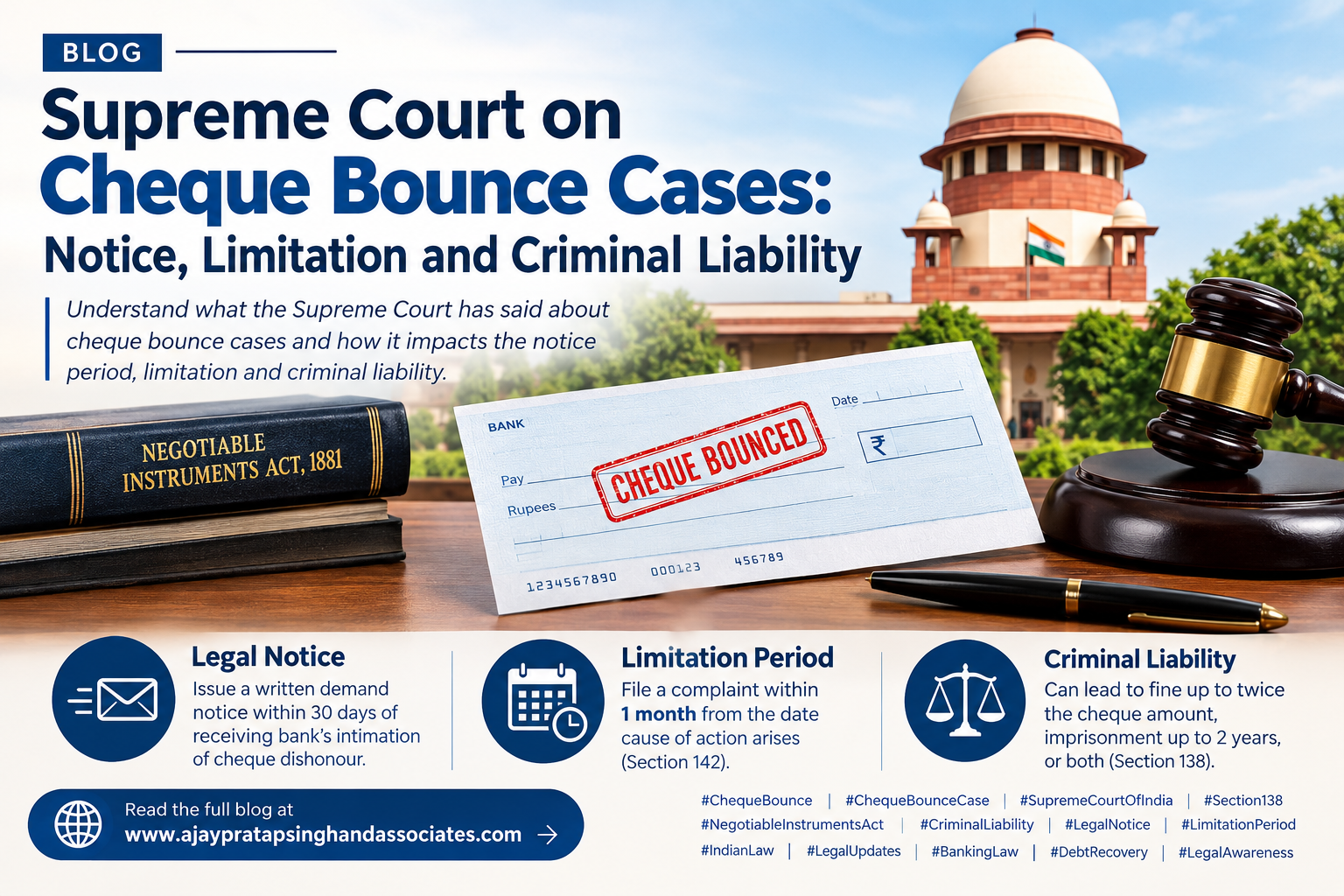
- A written demand notice must generally be issued within 30 days of receiving information from the bank about dishonour.
- The drawer has 15 days after receiving the notice to make payment.
- A complaint must generally be filed within one month after the cause of action arises, subject to the statutory provision permitting condonation of delay for sufficient cause.
- Section 139 creates a rebuttable presumption in favour of the cheque holder.
- Criminal liability depends on the statutory requirements and the facts of the case.
1. Understanding Section 138 of the Negotiable Instruments Act
Section 138 addresses cheque dishonour where a cheque drawn on an account is returned unpaid for reasons covered by the provision, including insufficient funds or exceeding an arrangement with the bank.
The cheque must have been issued for the discharge, wholly or partly, of a legally enforceable debt or other liability. The statutory conditions relating to presentation, notice and failure to pay must also be satisfied.
When can a cheque bounce lead to criminal proceedings?
A complaint under Section 138 may be maintainable when the relevant legal requirements are fulfilled, including:
- The cheque was issued towards a legally enforceable debt or liability.
- The cheque was presented within its validity period.
- The bank returned the cheque unpaid for a reason covered by Section 138.
- The payee or holder in due course sent a written demand notice within the prescribed period.
- The drawer failed to pay the demanded amount within 15 days of receiving the notice.
- The complaint was filed within the prescribed limitation period or delay was properly condoned where legally permissible.
The facts and documents of each case must be examined before determining whether these conditions have been met.
2. Legal Notice in Cheque Bounce Cases
The statutory demand notice is a crucial step in proceedings under Section 138. It gives the drawer an opportunity to pay the cheque amount before criminal prosecution can be initiated.
Time limit for sending the notice
Under the proviso to Section 138, the payee or holder in due course must generally send a written demand notice within 30 days of receiving information from the bank that the cheque has been dishonoured.
The notice should clearly identify the cheque and demand payment of the relevant amount. The sender should preserve the notice, postal or courier receipt, tracking information and other documents establishing dispatch and service.
What happens after the notice is received?
The drawer has 15 days from receipt of the notice to pay the cheque amount. If payment is made within this statutory period, the essential condition of failure to pay for prosecution under Section 138 is not fulfilled.
If the drawer does not make payment within the prescribed period, the cause of action arises after the 15-day period expires, and the payee may proceed in accordance with Section 142.
A complainant should not file the complaint prematurely. Compliance with the statutory sequence is important for maintainability.
3. Limitation Period for Filing a Cheque Bounce Complaint
Limitation is one of the most important issues in cheque bounce litigation. Missing a statutory deadline or filing a complaint too early can create significant legal complications.
One-month period for filing the complaint
Section 142(1)(b) generally requires the complaint to be filed within one month from the date on which the cause of action arises under Section 138.
The limitation period should be calculated carefully by considering the date of receipt of the notice, expiry of the 15-day payment period, applicable rules for computation of time and relevant procedural requirements.
Can a delayed complaint be accepted?
Section 142 permits a court to take cognizance of a complaint filed after the prescribed period if the complainant satisfies the court that there was sufficient cause for not filing it within time.
However, condonation of delay is not automatic. The complainant must present an adequate explanation, and the court must consider whether the statutory requirements for condonation have been met.
In S. Nagesh v. Shobha S. Aradhya, decided by the Supreme Court on 6 January 2026, the Court addressed a cheque bounce complaint in which cognizance had been taken before a short delay was condoned. The decision highlights the importance of complying with the statutory procedure for delayed complaints. The precise ruling should be read in the context of the facts and order in that case.
4. Criminal Liability in Cheque Dishonour Cases
Cheque dishonour can result in criminal prosecution, but liability is not established merely by showing that a cheque was returned unpaid.
Punishment under Section 138
Section 138 provides for imprisonment for a term that may extend to two years, a fine that may extend to twice the amount of the cheque, or both.
The court determines the appropriate outcome according to the law and the facts established in the proceedings.
Importance of a legally enforceable debt
The cheque must relate to a legally enforceable debt or other liability. A dispute about the existence, nature or enforceability of the debt may therefore become relevant.
The Supreme Court has explained that statutory presumptions under the Negotiable Instruments Act operate according to the applicable legal principles, but they are rebuttable. The accused may seek to rebut the presumption through legally admissible evidence and circumstances that make the defence reasonably probable.
Liability of directors and company officers
Where a cheque is issued by a company, Section 141 may become relevant. It addresses circumstances in which the company and persons responsible for the conduct of its business may be prosecuted.
A director or officer is not automatically criminally liable merely because of their designation. The statutory requirements concerning responsibility for the company’s business and the allegations in the complaint must be considered.
5. Presumption Under Section 139 of the NI Act
Section 139 provides a presumption in favour of the holder of a cheque that it was received for the discharge, wholly or partly, of a debt or other liability, unless the contrary is proved.
This presumption is important because it affects how evidence is evaluated during a cheque bounce trial.
Can the accused rebut the presumption?
Yes. The presumption is rebuttable. The accused may rely on relevant documents, transaction records, communications, surrounding circumstances and other admissible evidence to challenge the existence or enforceability of the alleged liability.
The applicable standard for rebutting the statutory presumption differs from the prosecution’s ultimate burden of proving criminal guilt. The court evaluates the evidence under the principles established by the Supreme Court.
In Renuka v. State of Maharashtra, decided on 7 April 2026, the Supreme Court considered Sections 138 and 139 in the context of the stage at which a complaint proceeds to trial. The decision discusses the significance of statutory presumptions and the need to evaluate a defence in the appropriate procedural stage rather than prematurely resolving disputed factual questions.
The case illustrates why the stage of proceedings and the evidence available matter when assessing a cheque bounce dispute.
6. Common Mistakes in Cheque Bounce Litigation
Procedural errors can weaken a complaint or complicate the defence. Common issues include:
- Sending the demand notice after the statutory 30-day period without properly examining the legal position.
- Failing to preserve proof of dispatch or service of the notice.
- Filing a complaint before the statutory cause of action has arisen.
- Miscalculating the one-month limitation period.
- Failing to explain a delay when seeking condonation.
- Ignoring documents relevant to whether the debt was legally enforceable.
- Naming company officers without properly addressing the requirements of Section 141.
- Assuming that every cheque dishonour automatically proves criminal liability.
A careful review of the cheque, bank return memo, transaction documents, notice and delivery records can help identify important legal issues at an early stage.
7. Practical Steps for the Payee and the Drawer
For the payee or cheque holder
The payee should preserve the original cheque, bank return memo, transaction records, demand notice and proof of dispatch or delivery. Dates should be recorded carefully to ensure compliance with the statutory timelines.
If the drawer does not pay within the 15-day period after receipt of the notice, the payee should obtain legal advice promptly about filing a complaint within the prescribed limitation period.
For the drawer of the cheque
The drawer should review the notice promptly and verify the underlying transaction, amount claimed and relevant records. If the demand is disputed, legal advice can help identify appropriate responses and available legal remedies.
Ignoring a statutory notice may create avoidable complications. Any response or settlement should be considered in light of the actual facts and applicable law.
8. Why Supreme Court Judgments Matter in Cheque Bounce Cases
Supreme Court judgments help clarify the interpretation of Section 138, the statutory notice procedure, limitation requirements, presumptions regarding debt and the liability of individuals associated with companies.
However, a judgment must be read in its proper context. A decision about condonation of delay may not resolve every question concerning service of notice or the existence of a debt. Likewise, a ruling on statutory presumptions does not mean that every defence must fail.
Readers should verify the full judgment, case name, date, legal provisions and final directions before relying on a case in litigation.
The official Supreme Court website, https://www.sci.gov.in/, and the India Code portal, https://www.indiacode.nic.in/, are useful starting points for checking judgments and statutory provisions.
For information about legal assistance, visit https://manindersinghandassociates.in/.
Frequently Asked Questions
1. What is the time limit for sending a cheque bounce notice?
A written demand notice must generally be sent within 30 days of receiving information from the bank about the dishonour of the cheque.
2. How many days does the drawer get to pay after receiving the notice?
The drawer has 15 days from receipt of the statutory notice to pay the cheque amount.
3. What is the limitation period for filing a complaint?
A complaint must generally be filed within one month from the date the cause of action arises. A court may condone a delay where the statutory requirements and sufficient cause are established.
4. Does every bounced cheque lead to criminal liability?
No. The requirements of Section 138 must be satisfied, including the requirement that the cheque relates to a legally enforceable debt or liability and that the prescribed notice and payment periods have been complied with.
5. Can the accused challenge the debt underlying the cheque?
Yes. The accused may seek to rebut the statutory presumption through admissible evidence and relevant circumstances. The court assesses the defence under the applicable legal standards.
6. Where can Supreme Court cheque bounce judgments be verified?
Judgments can be checked through the official Supreme Court website at https://www.sci.gov.in/. The full decision should be reviewed before relying on a legal proposition.
Conclusion
Cheque bounce cases require careful attention to statutory notice, limitation and the legal requirements for establishing criminal liability. Section 138 of the Negotiable Instruments Act provides a specific procedure that must be followed before prosecution can proceed.
The Supreme Court’s interpretation of these provisions helps courts and litigants understand the importance of legally enforceable debt, statutory presumptions, proper notice and timely complaints. Both complainants and accused persons should review the facts and documents carefully and seek qualified legal advice where necessary.
For more information about legal services, visit https://manindersinghandassociates.in/.
Legal Disclaimer: This article is for general informational purposes only and does not constitute legal advice. The outcome of a cheque bounce case depends on the facts, evidence, applicable statutory provisions and relevant judicial decisions.